

Thow Kwang Dragon Kiln
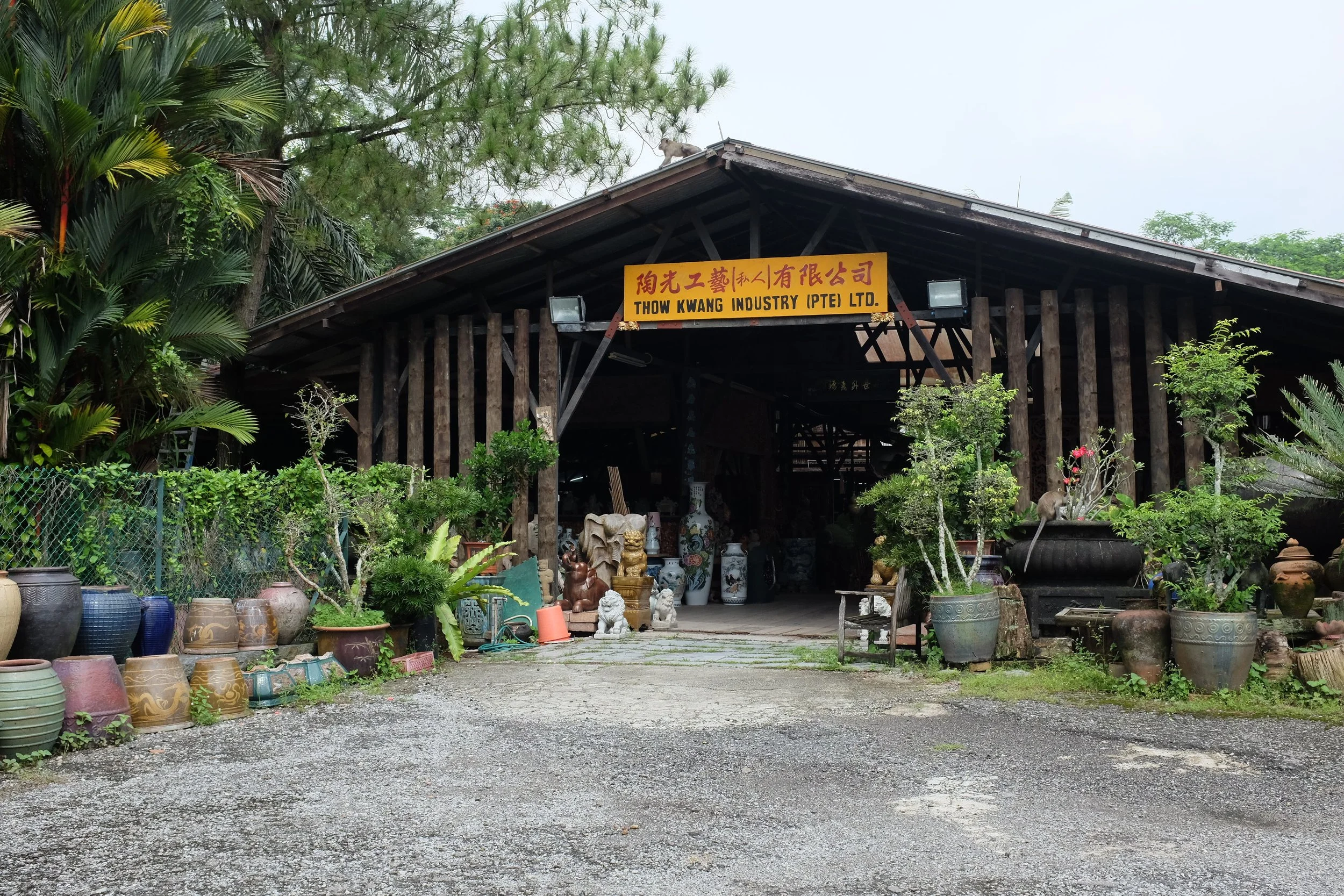
This is one of only two such kilns remaining in Singapore today, and the only example that is still operational.¹ The Thow Kwang Dragon Kiln was constructed in 1940 by immigrants from Chaozhou and Fujian, on what was thought to be an older Hokkien three chamber kiln.² In 1965, the kiln was then bought over by Mr. Tan Kim Seh, who founded Thow Kwang at its current site.
More than ten dragon kilns were scattered across the 10th to 15th milestones of Jurong Road in the 1960s. Another example is the neighbouring Guan Huat Dragon Kiln (now known as Jalan Bahar Clay Studios), which still exists but is no longer operational. Together, such kilns supported a village that made pottery and ceramics for a living alongside agriculture cultivation and animal husbandry.³
For almost a century, kilns such as Thow Kwang supported the growth and development of Singapore by supplying ceramic products for industrial and then everyday use. It is estimated that there used to be at least 20 kilns in Singapore, mostly run by the Hokkien and Teochews. Besides Jurong, they were scattered across Yio Chu Kang and Pulau Tekong where clay suitable for pottery could be found.⁴ Teochew kilns, such as Thow Kwang, can be traced to Fengxi Town in Chaozhou, Guangdong Province, China, which is regarded as the hometown for many Teochew potters. Dragon kilns settled in Jurong due to several factors. The primary reason was the area’s white sedimentary clay, which was ideal for producing functional products such as water jars. In the early 1960s, Jurong was also near rubber plantations that demanded latex cups to collect sap from the trees, which such kilns manufactured. In turn, the plantations’ chopped rubber trees supplied firewood for them.
As orchid plantations for export sprouted in Singapore during the 1970s, kilns like Thow Kwang started making ceramic pots to support them too.⁵ When industry needs shifted in the 1980s, Thow Kwang’s output also gradually shifted towards consumer products such as flower pots for new homes as well as urns that supported the growing popularity of cremation services.⁶ Subsequently, it entered the import and export business. In the 2000s, Thow Kwang began offering its kiln as an educational space to raise awareness of the heritage of ceramic production in Singapore.
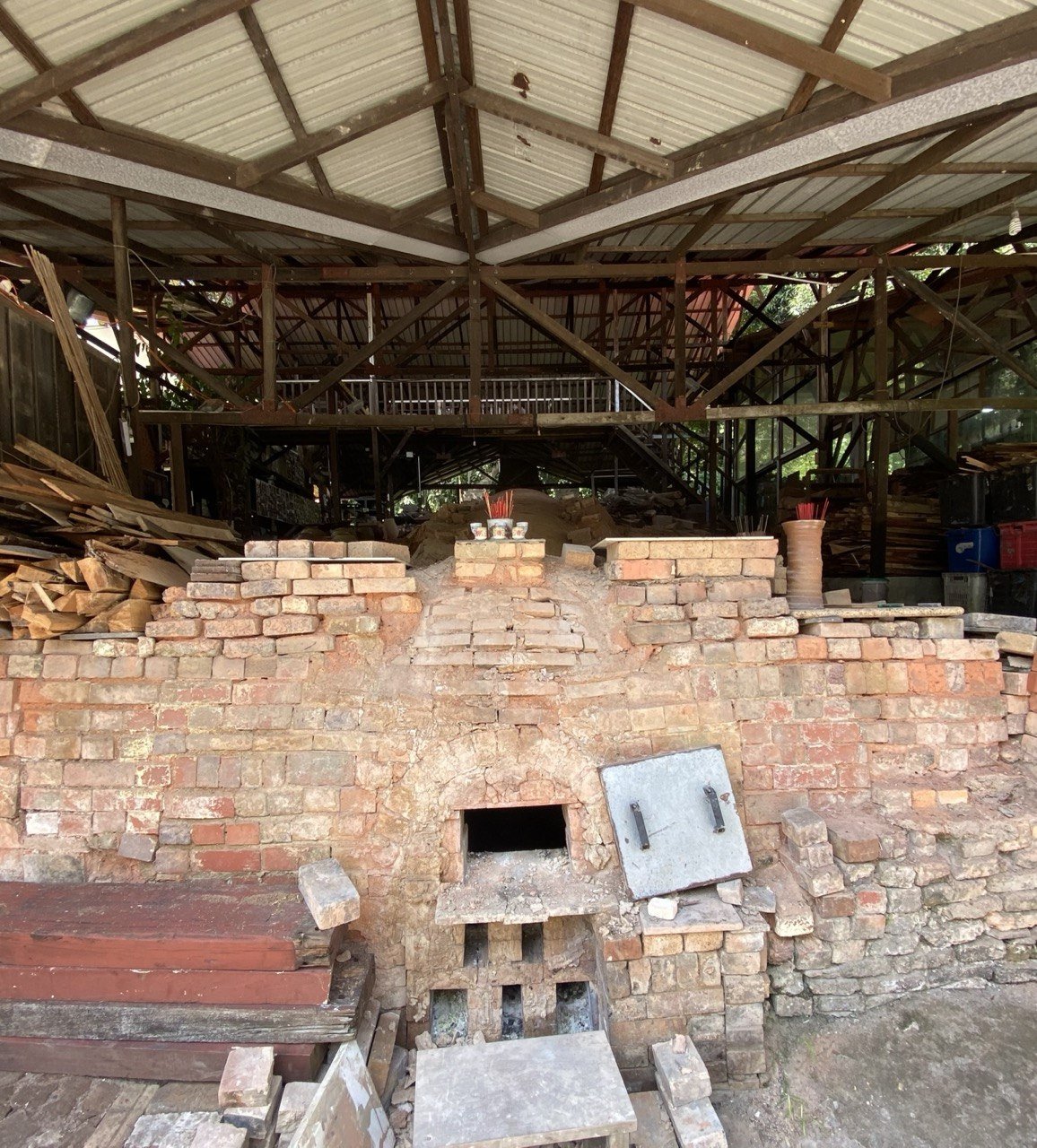
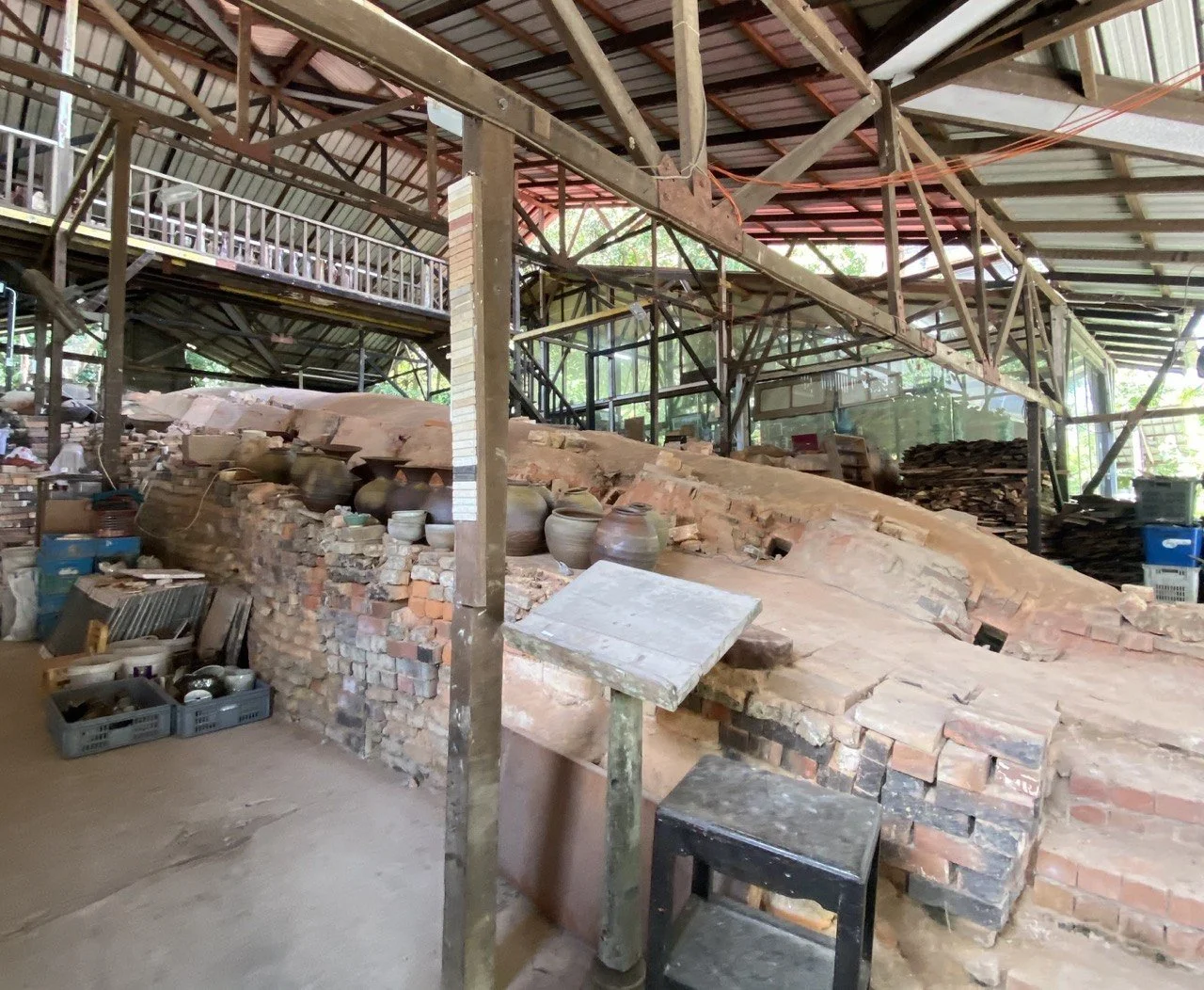
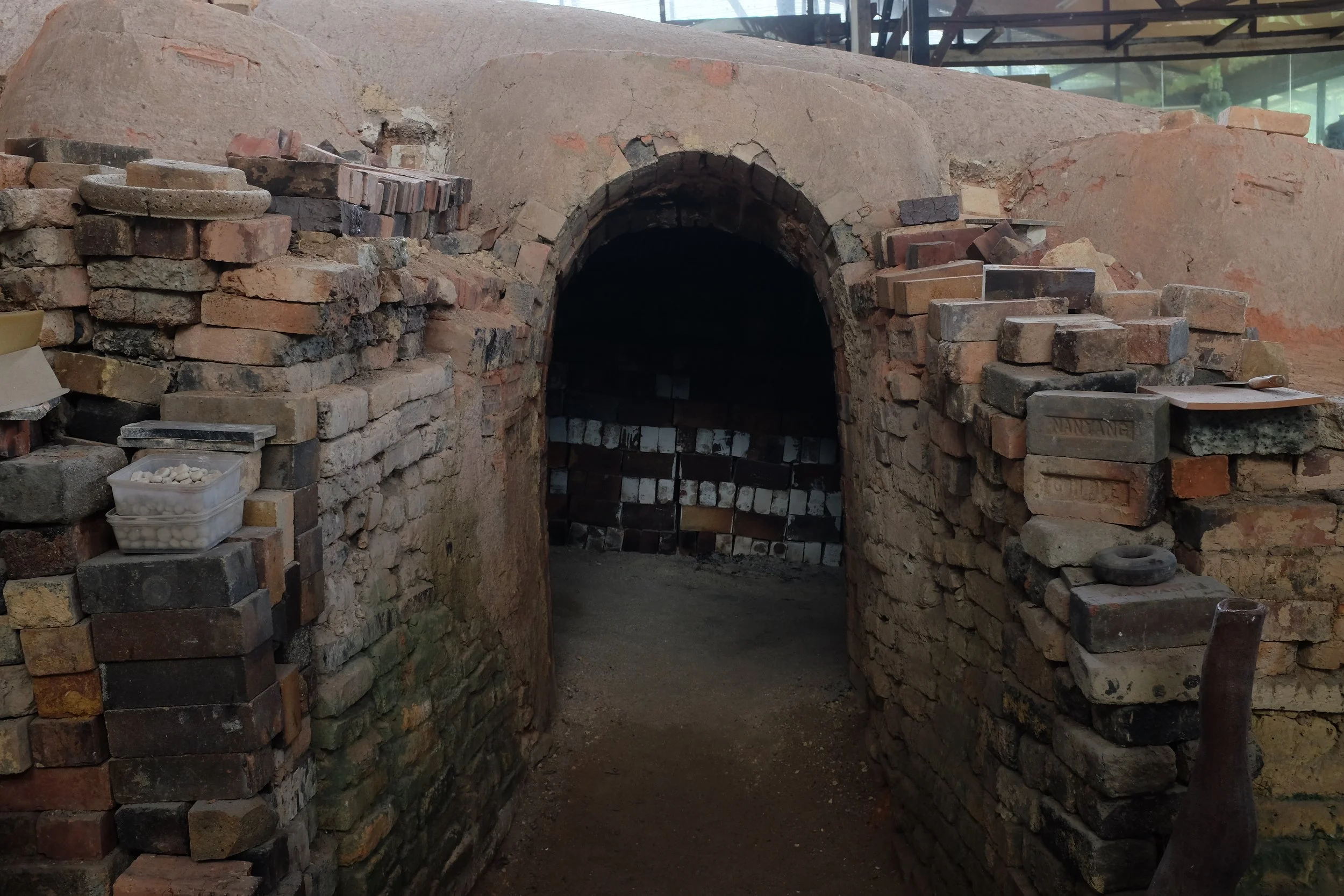
Dragon kilns enable the practice of traditional wood-firing, which is distinct for producing a natural ash glaze. This is achieved through the reaction of flying ash and volatile salt thrown into the kiln during the firing process that fuses and melts into the clay in varied ways—a method that is not possible with gas and electric kilns.⁷ A dragon kiln is characterised by its “head”, “body”, and “tail” built upon a slope or hill. The “head” or firebox is where firewood is fed and placed at the bottom, while the “body” of the kiln is where the pottery is placed and sits above. The “tail” facilitates the pushing of smoke out the chimney with rising hot air.⁸ The entrances of the kiln are sealed during firing, and the fire condition can be observed via the “eyes” or stoke holes located along the “body”. The 27-metre-long dragon kiln at Thow Kwang has 17 pairs of stoke holes along its length. Its lower front chambers are less than a metre wide, and expand to about two metres at the back. The back of the kiln is a nine-hole brick damper wall where smoke and heat rise along the incline before escaping via the chimney. At the sides, circular humps of bricks spaced at intervals support the kiln structure. These also act as doorways, and are lined with bricks carrying the names of old brick manufacturers in Singapore, such as Bee Kiow, Nanyang and Jurong (which was located at the 12th milestone).⁹ The kiln is thus also an archive of Jurong’s past life as a home to brickworks which operated in the area since the 1920s.¹⁰
The Thow Kwang Dragon Kiln exists as part of what is today known as the Thow Kwang Pottery Jungle. The compound comprises two distinct single to double-storey houses connected with a sheltered roof. They are both constructed with metal beam and post structure and trusses that allow for a long span over the main compound. Subsequent additions were of timber beam and post construction, and a gap between the two roofs serving as ceiling vents for ventilation. Corrugated metal pitch roofs are used consistently across the compound. The Southwest block mostly houses pottery and other art pieces, while the Northeast block contains pottery pieces, a pottery workshop area, and the dragon kiln. The latter’s roof follows the incline of the dragon kiln, gradually terracing down from the “tail” of the dragon to the “head” of the dragon with ceiling vents.
Today, Thow Kwang is surrounded by the industrial estate CleanTech Park and a five-hectare public park. They are part of Jurong Innovation District, an upcoming industrial development by JTC Corporation. In 2025, the public park was renamed from Jurong Eco-Garden to Potter’s Garden to commemorate the area’s pottery legacy and Singapore’s last two dragon kilns.¹¹
Location: 85 Lorong Tawas, Singapore 639823
Architect: −
Year: 1940
Status: Not Conserved
Woo, S. (2025, October 15). Inside a dragon kiln where temperatures go up to 1,300°C. CNA. https://www.channelnewsasia.com/today/in-pixels/pictures-singapore-only-operational-dragon-kiln-firing-rare-gathering-4745411
Lim, J. (2011, June 29). Into the belly of the Dragon. The Long and Winding Road. https://thelongnwindingroad.wordpress.com/2011/06/29/into-the-belly-of-the-dragon/
Tan, T. Y. (2009, April). Vanishing trades. National Archives of Singapore. https://www.nas.gov.sg/archivesonline/oral_history_interviews/record-details/b5dab08d-1161-11e3-83d5-0050568939ad
National Heritage Board. (2018, April). Making of Wood-Fired Pottery. Roots. https://www.roots.gov.sg/ich-landing/ich/making-of-wood-fired-pottery
Singapore Memory Project, & Tan, T. Y. (n.d.). Thow Kwang Pottery Jungle. National Library Board. https://www.nlb.gov.sg/main/article-detail?cmsuuid=A-0cc06dff-dc0c-4286-9849-dda444212eb2
Singapore Memory Project, ‘Thow Kwang Pottery Jungle’.
National Heritage Board. Making of Wood-Fired Pottery.
National Heritage Board. Making of Wood-Fired Pottery.
Lim, C. (2015, September). The dragon kiln breathes. MuseSG Volume 8, Issue 2. https://www.roots.gov.sg/en/stories-landing/stories/the-dragon-kiln-breathes-thow-kwang-dragon-kiln/story
National Heritage Board. Making of Wood-Fired Pottery.
‘The Potter’s Garden at JTC’s Jurong Innovation District Opens to the Public’. JTC, 16 November 2025. https://www.jtc.gov.sg/about-jtc/news-and-stories/press-releases/the-potters-garden-at-jtc-jurong-innovation-district-opens-to-the-public.
Last modified on 12 May 2026. Written by Tang Wei.