

Former McGraw-Hill Far Eastern Publishers
The establishment of McGraw-Hill Far Eastern Publishers factory in 1969 signalled the beginning of American industrial investment at Jurong Industrial Estate. Giving a speech at its opening, then Minister of Finance Dr Goh Keng Swee noted that the price of rapid economic growth in Singapore was a fierce rat race which may result in unhappy side effects, such as citizens opting out of being productive.¹ At a time when counterculture movements, such as hippie subculture, were rampant in the Western world, Dr Goh’s moral panic was directed at foreign media with its “unwholesome obsession with crime, murder and mayhem”.² Instead of such media, which supposedly stimulated anti-industrialist fantasies, Dr Goh advised Singaporeans to turn to books. Cast your paperback murder mysteries or chick lit aside because, according to him, the writings of the scholar-poets of the Tang dynasty, and the ancient Greek philosophers, have therapeutic qualities which can sustain the psychic well-being of modern communities.
This cultural push amid budding foreign investment set the stage for the McGraw-Hill Far Eastern Publishers factory. Sprawling across a 12-acre plot, it was reportedly the largest publishing-printing complex in the whole of Southeast Asia and the first to export its publications internationally.³ The US$30 million (approx. US$278 million in 2025) joint venture was expected to export 90% of its manufactured products to the West Indies, Africa, Oceania, Middle East, Southeast Asia and East Asia. It had the capacity to produce 45 million books a year and was expected to employ over 1,000 workers.⁴ The landmark development also hailed the expansion of Jurong Industrial Estate further west—past Jurong Town and Jalan Boon Lay.
BEP Akitek was tasked to accommodate the scale and complexity of such an operation. It had to house multilingual editorial teams, a film library for storing original publications, various graphic production departments, a bindery and even an on-site medical clinic. There were also corporate white-collar departments like marketing and sales. Above all, there was the Production Control department that oversaw the quality of both the physical goods as well as their intellectual content, since the two are inextricably linked in the world of media publishing. BEP Akitek responded by providing elegant and delightful spaces that holistically combined blue- and white-collar functions in a heavily industrial estate—what was considered an unusual design for the factory typology at the time.
The site of the factory, despite its levelled appearance, sloped gently from the front (facing Jalan Boon Lay) to the rear (facing the drainage canal). Writing for the April 2005 issue of Singapore Architect magazine, Dinesh Naidu notes how BEP Akitek used this elevational change to great effect by sinking the front-facing block by half a level, minimising the height of the building to create a “ground-hugging” form for the building by emphasising its footprint.⁵
With a strong formal connection to the land it sits upon, the four main blocks which enclosed the factory are punctuated by a courtyard with the company boardroom housed in a ‘floating’ pavilion amid a pool and water feature. A parade of cascading umbrella canopies shelter staff and guests from the tropical heat and rain as they descend a flight of stairs from the front block to the boardroom. Paved terraced platforms framed by low retaining walls interspersed with shrubbery complement the natural landscape; the soothing sound of falling and flowing water throughout a picturesque scene provides relief from the harsh industrial environment.
This landscaped courtyard is the central unifying space integrating the administrative and industrial spaces, a shared amenity for their respective workers. Towards the front of the site, the administrative buildings are formed by two interlocking ‘L’-shaped blocks looking towards the courtyard. Meanwhile, at the rear end, simple and practical industrial sheds share the view of the courtyard from their canteen and recreation areas. The courtyard that sits in between these two programs, as Naidu writes, is the centrepiece of this human and dignified working environment, a source of shared pride for the workers.
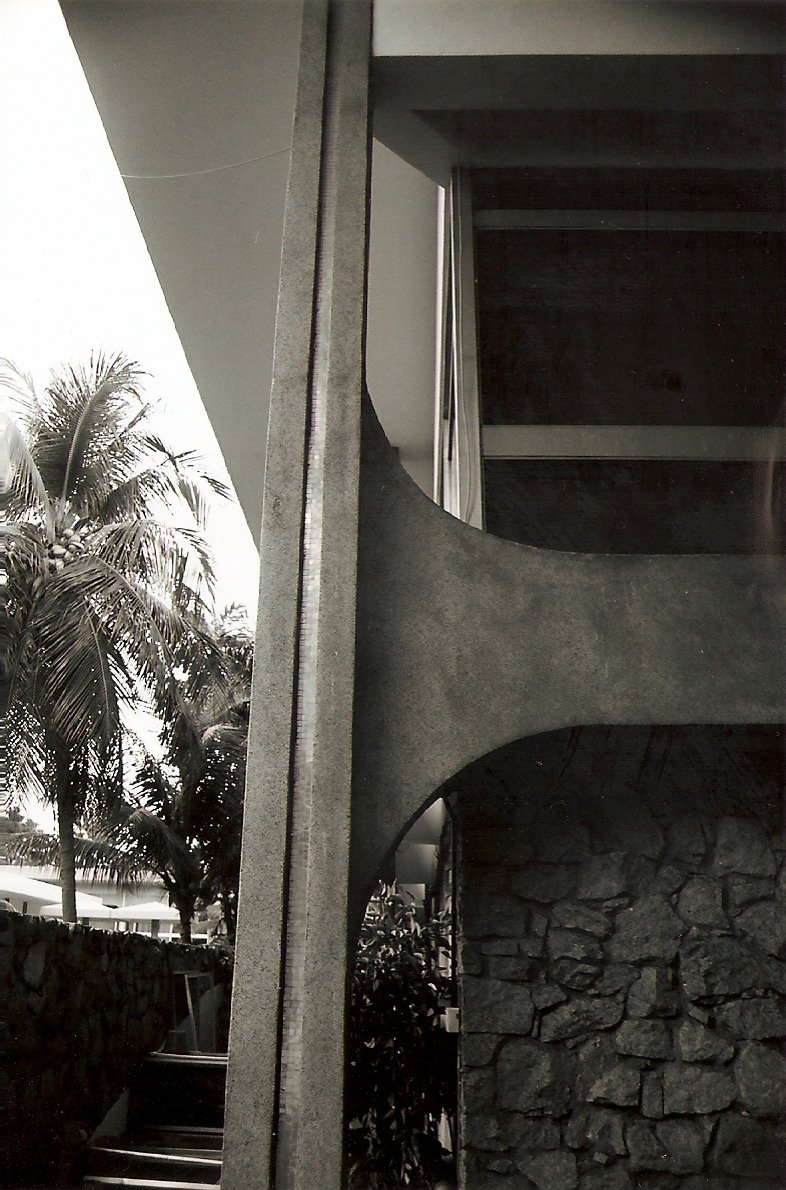
Stylistically, the factory’s cantilevered concrete roof is supported by a row of elegant columns set slightly in front of the external wall. A series of beams connect the columns at about one-third the way up, their curvilinear diverging ends creating rounded corners to soften an otherwise rectilinear façade. This H-shaped frame has a tactile granolithic finish which contrasts the smooth glass and plaster surfaces behind it. Attention was also paid to ornamentation. Each column had a groove running down the middle which contained three lines of bronze tiles that ran from top to bottom, giving the building a slight glint as sunlight bounced off their surfaces. The full-length ribbon windows which wrap around the block, are shaded by the overhanging roof. It allows natural light into the interior, and a view into the landscaped courtyard, while reducing solar heat gain for better air-con energy efficiency.
It is one thing to have been the first factory of its operational scale and complexity. It is another to have achieved that in an architecturally expressive manner whose spaces support its workers. The McGraw-Hill Far Eastern Publishers factory expresses order in its form, clarity in its spaces, and craft in its details, all while providing a functional and egalitarian place for its users—an example of elegance and rationality of Modern design. It is no wonder Naidu asked in his review of the factory: “Why shouldn’t industrial environments be delightful? Why can’t factory workers and senior professionals share and appreciate the same, well-crafted spaces?”
Despite the fanfare to mark its opening, McGraw-Hill Far Eastern Publishers struggled to make a profit and there were questions about how the company handled its funds.⁶ Around 1975, the Americans pulled out of the joint venture. The remaining company, FEP International, struggled from one financial crisis to another over the next decade. Around 1989, the factory was sold to PSC Group (now known as PSC Corporation), a manufacturer and distributor of fast-moving consumer goods. They have extensively renovated the premises over the years, and it is unclear what remains of the original design.⁷
Location: 348 Jalan Boon Lay, Singapore 619529
Architect: BEP Akitek
Year: 1969
Status: Not Conserved




Goh, Keng Swee. ‘Text of Speech by the Minister for Finance, Dr. Goh Keng Swee, at the Opening of McGraw Hill Far Eastern Publishers (S) Ltd., at Jalan Boon Lay, Jurong, on Sunday, November 16, at 5 p.m.’ Ministry of Culture, 16 November 1969. https://www.nas.gov.sg/archivesonline/speeches/record-details/796439d0-115d-11e3-83d5-0050568939ad.
Goh, “Text of Speech by the Minister for Finance”.
Eastern Sun (Singapore). ‘Dr. Goh to Open Giant Publisher-Cum-Printing Complex’. 16 November 1969.
The Straits Times (Singapore). ‘One of World’s Largest Publishers’. 15 April 1969.
Naidu, Dinesh. ‘BEP Akitek: Former McGraw-Hill Far Eastern Publishing Factory’. Singapore Architect (Singapore), no. 226 (April 2005): 128–37.
Quek, Peck Lim. ‘Receivers to Take over Cho’s FEP’. The Business Times (Singapore), 6 January 1977.
Naidu. ‘BEP Akitek: Former McGraw-Hill Far Eastern Publishing Factory’.
Last modified on 22 April 2026. Written by Chua Min Chi.